StATS: What is specificity?
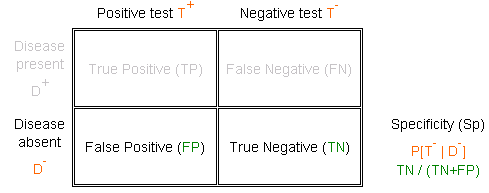
The specificity of a test is the probability that the test will be negative among patients who do not have the disease. Specificity is sometimes abbreviated Sp. The formula for specificity is
Sp = TN / (TN + FP)
where TN and FP and the number of true negative and false positive results, respectively. You can think of specificity as 1 - the false positive rate. Notice that the denominator for specificity is the number of healthy patients. Using conditional probabilities, we can also define specificity as
Sp = P [ Test is negative | Patient is healthy ]
The following table summarizes these calculations.
A large specificity means that a positive test can rule in the disease. David Sackett coined the acronym "SpPIn" to help us remember this.
Here is an example of a specificity calculation.
This page was written by Steve Simon while working at Children's Mercy Hospital. Although I do not hold the copyright for this material, I am reproducing it here as a service, as it is no longer available on the Children's Mercy Hospital website. Need more information? I have a page with general help resources. You can also browse for pages similar to this one at Category: Definitions, Category: Diagnostic testing.